
Most homeowners who ask us about James Hardie siding have already decided they can’t afford it. They’ve heard the fiber cement pitch, they like the look, and then they see the number and move on to vinyl. The hardie board vs vinyl siding decision gets treated like an either/or — premium or budget, pick one.
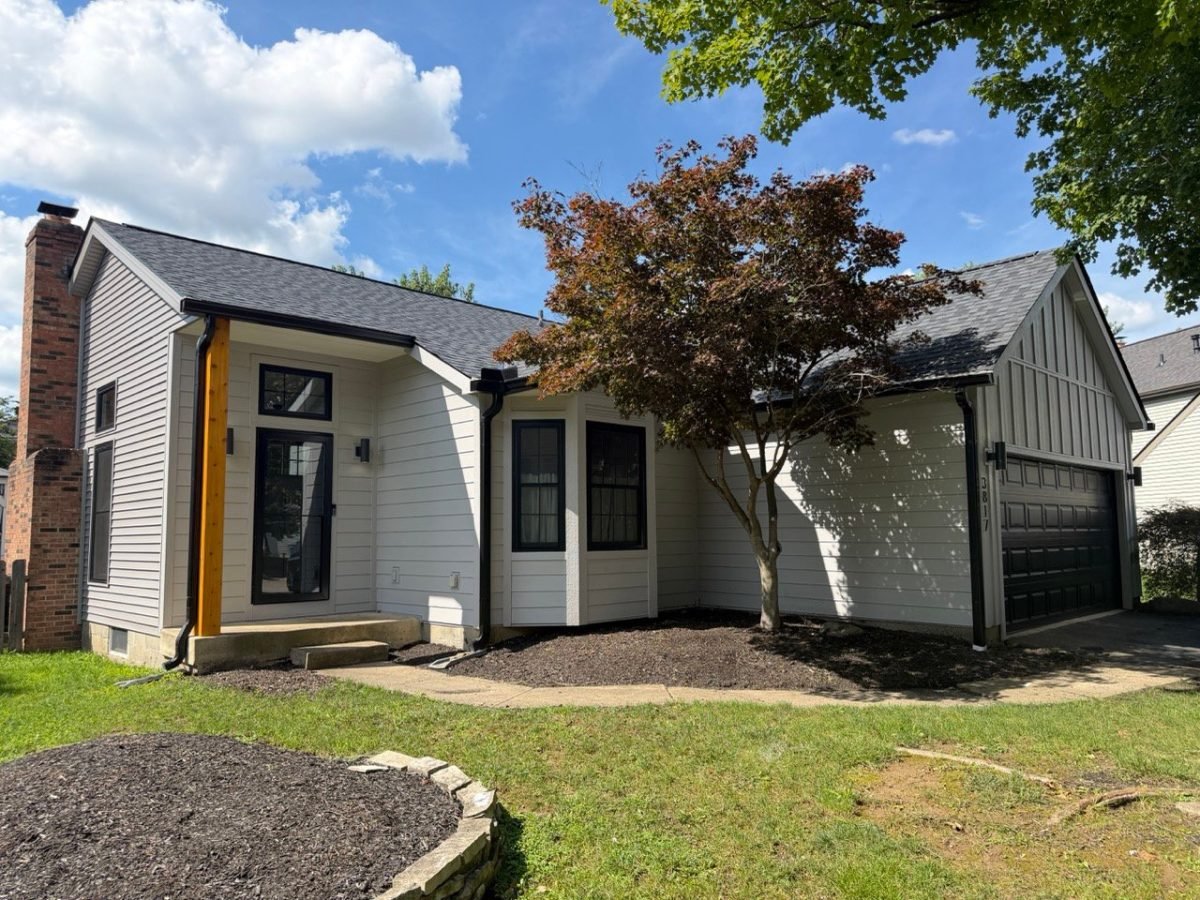
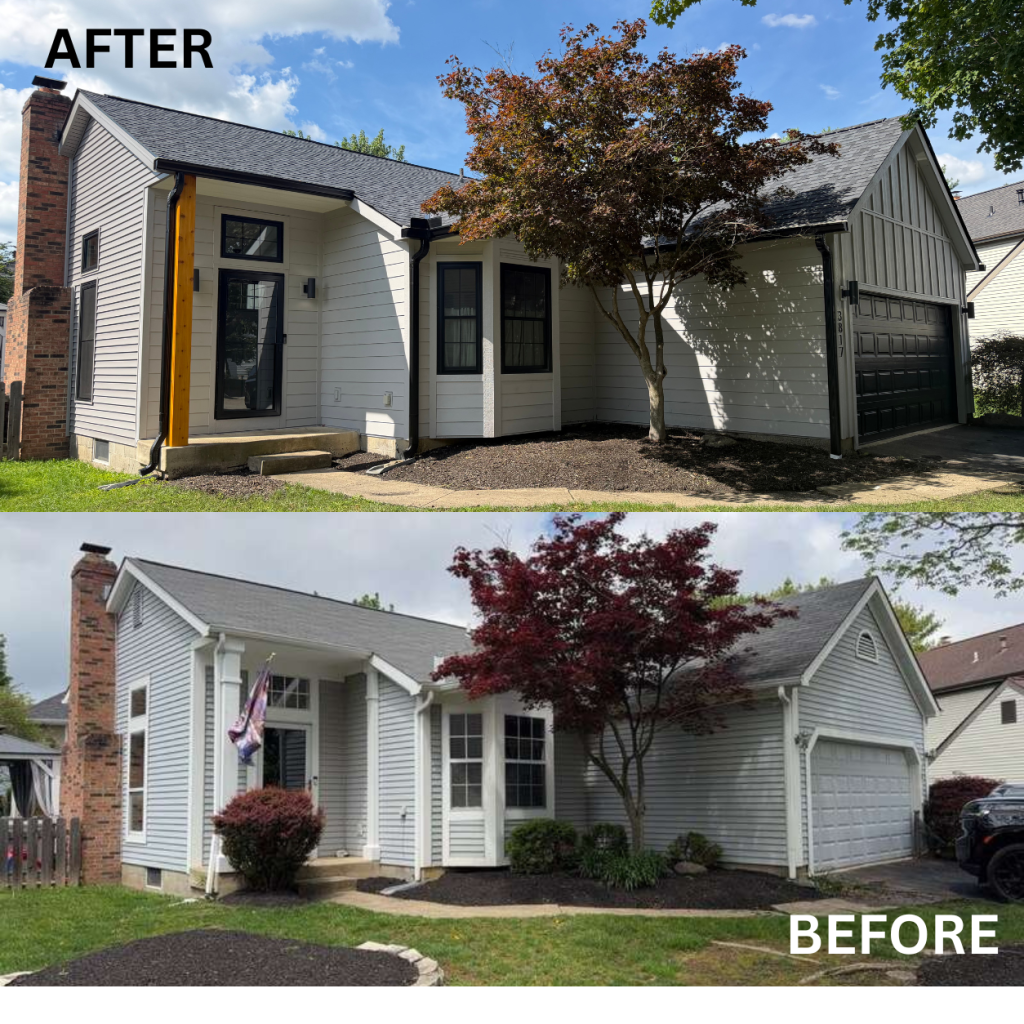
It isn’t. On a recent Central Ohio project we wrapped the front elevation in James Hardie and did the sides and back in vinyl. From the street the house reads as a full Hardie home. The budget landed much closer to a vinyl job than a Hardie one.
Hardie board vs vinyl siding: what you’re actually paying for
Both materials will keep water out of your house. The differences show up in how they look up close, how they handle Ohio weather, and what they cost.
James Hardie fiber cement is a mix of cement, sand, and cellulose fiber. It’s thick, rigid, and heavy. It holds a crisp shadow line at the edges, takes paint the way wood does, and doesn’t warp or sag in summer heat. It won’t melt, and freeze-thaw cycles don’t make it brittle. The tradeoff is weight and labor — it takes more crew, more time, and specialized cutting.
Vinyl siding is extruded PVC panels. Modern insulated vinyl is a real improvement over what most people picture: better rigidity, better color retention, and a foam backing that adds a bit of R-value. It installs fast, needs almost no maintenance, and costs a fraction of fiber cement installed. Up close the panels are thinner and the seams are more visible, and in deep cold it can crack under a hard impact.
Here’s the part that drives the strategy: the visual gap between the two is far more obvious on the front of a house than on the sides. Front elevations get looked at from 30 feet away, straight on, in good light. Side walls get glimpsed at an angle, often half-blocked by a fence, a neighbor’s house, or landscaping.
Why mixing siding materials works
Curb appeal is almost entirely a front-elevation phenomenon. It’s what buyers see in the listing photo, what appraisers photograph, and what your neighbors register when they drive past. That’s a small percentage of your home’s total wall area doing nearly all of the visual work.
Putting your material budget where the eyes actually go is not a compromise — it’s just allocation. You get:
- The Hardie look where it counts. Deeper shadow lines, thicker profile, and the paint finish that makes a facade look intentional rather than clad.
- Vinyl economics on 60–70% of the wall area. The sides and rear are usually the majority of the square footage and the minority of the visual impact.
- Low maintenance everywhere. Neither material needs the scraping and repainting cycle that wood does.
- A realistic path to Hardie at all. For a lot of homeowners the choice isn’t Hardie versus a hybrid. It’s a hybrid versus no Hardie.
Making the transition look deliberate
This approach fails when the material change looks like someone ran out of money halfway around the house. Done right, nobody notices there was a change at all.
The details that matter:
- Break at an inside corner, not an open wall. Corners give the eye a natural stopping point. A transition in the middle of a flat wall reads as a mistake every time.
- Match the color across both materials. Hardie’s finish and vinyl’s color are formulated differently, so this takes real sample comparison in daylight, not a catalog match.
- Match the exposure. If the Hardie is a 7-inch reveal, the vinyl should be too. Mismatched course lines at a corner are the giveaway.
- Carry the trim. Using the same trim package around the corner ties the elevations together more than the siding itself does.
- Account for thickness. Fiber cement is meaningfully thicker than vinyl. That transition needs to be detailed properly at the corner or you get an ugly reveal.
When it isn’t the right call
We’d rather tell you this upfront than after the estimate.
Corner lots and homes with high side visibility. If two elevations face a street, “the front” isn’t one wall anymore. The math changes and often full Hardie makes more sense.
HOA and historic districts. Some Central Ohio neighborhoods have material requirements that make mixed cladding a nonstarter. Worth checking before you fall in love with the plan.
If you’re staying 25+ years. Fiber cement’s service life is long enough that on a very long hold, full Hardie can win on lifetime cost. The hybrid is strongest for homeowners on a normal ownership horizon or preparing to sell.
Homes where the sides take a beating. A wall that catches direct west sun and driving weather, or one where kids and mowers are constantly making contact, may justify the tougher material regardless of who sees it.
What to ask before you sign
If you’re getting quotes on a mixed-material job, make sure the estimate spells out which elevations get which material, where exactly the transition falls, whether the trim package is consistent, and how the corner detail is handled. A contractor who hasn’t thought about the transition point hasn’t really planned the job.
It’s also worth asking about the substrate. Pulling old siding often reveals sheathing or moisture problems, and you want to know how that gets handled before it becomes a change order.
Talk it through with a Central Ohio siding contractor
Every house divides differently. The right split depends on your elevations, your lot, your neighborhood, and how long you plan to stay — which is why this is a walk-the-property conversation rather than a formula.
Exterior Alliance installs both James Hardie fiber cement and insulated vinyl across Central Ohio, so we have no stake in steering you toward one. We’ll walk your home, show you where the transition would fall, and price it both ways so you can see the actual difference.
We handle siding replacement throughout the region, including Columbus, Dublin, Westerville, New Albany, and Upper Arlington. You can see all our siding service areas or read our complete guide to James Hardie siding and our breakdown of James Hardie siding panels if you want to go deeper on the material first.
Contact us to schedule a free consultation and see what the hybrid approach would look like on your home.
